

Reviewed · NAIROBI TOURS
Kevins Kibera Slum Tours
Kibera is not a museum of poverty. It is a working community, and this private tour lets you walk through it with someone who grew up there. Kevin and his brother Ismael guide you through the market, a school, workshops, and their family homes, explaining daily life along the way. I like the local connection and the chance to meet people in places most Nairobi tours never reach.
I also like the small private format. Your group gets time to ask questions, move at its own pace, and hear personal stories rather than a canned speech. The main caution is the footing. Paths can be muddy, narrow, uneven, and difficult after rain, so this is not a good choice if you have serious balance or walking problems.
Key points to know before booking
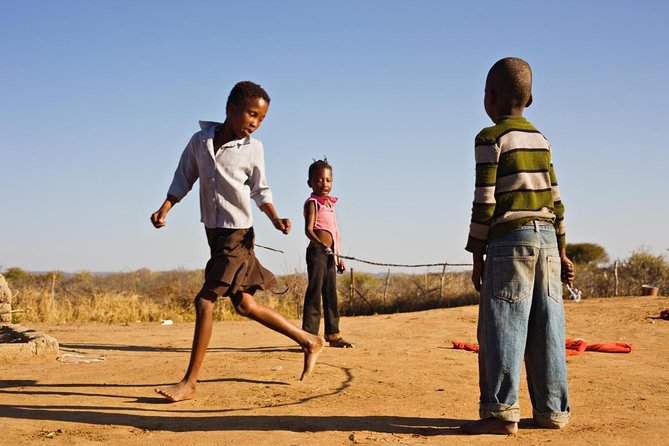
- A guide who grew up in Kibera: Kevin or his brother Ismael leads you through a place they know as home.
- A family visit: You may be welcomed into the guide’s home and meet members of his family.
- More than a street walk: The route can include a school, orphanage, bone workshop, bag-making project, market, landfill, and train track.
- Private for $65 per person: Hotel pickup and drop-off are included, making the price reasonable for a personal half-day outing.
- Demand is steady: The tour is booked about 27 days ahead on average, so do not leave it until your final day in Nairobi.
- Bring sturdy shoes: Closed-toe footwear that can get dirty is the sensible choice.
Meeting Kibera through a local guide
The most important part of this tour is who leads it. Kevin and Ismael are connected to Kibera by family, childhood, and daily life. That changes the tone of the walk. You are not simply being shown a poor neighborhood from the outside. You are being guided by someone who can explain where people shop, study, work, worship, and raise children.
That personal link also helps with introductions. The guides are known in the area, and that can make the walk feel more natural and less like a stranger wandering around with a camera. Several accounts describe feeling safe with Ismael or Kevin, including a woman touring alone. Still, I would treat that as a benefit of having a trusted local guide, not a reason to ignore normal city awareness.
The tour is private, so only your group takes part. That matters here. Kibera is full of tight paths and small spaces, and a large group would make the experience clumsy. A private format also gives you room to ask about subjects that interest you, from education and family life to sanitation, work, and local efforts to improve conditions.
The listed start time is 8:00 a.m. Front-door pickup and return are offered from hotel accommodation in Nairobi. The walk itself is listed at about three hours, while the full experience takes roughly four hours once transfers and stops are counted.
More community walks in Kibera:
- Nairobi: Explore Kibera Slum with Local Guides
★ 4.9 · 365 reviews - Nairobi: Kibera Slum storytelling tour with a Local
★ 5.0 · 185 reviews - Kibera Slum Tour with Lucas
★ 5.0 · 119 reviews
Walking the main street market

The market is one of the clearest ways to see Kibera as a place where people get on with ordinary business. You will see where residents shop and trade, rather than only focusing on the hardships that outsiders expect to find.
This part of the tour gives useful context. A settlement can have difficult living conditions and still have commerce, friendships, ambitions, humor, and routines. The market helps you keep that balance in mind. It is easy for a short slum tour to reduce people to a sad story. A local guide can show you the daily activity that a label such as slum leaves out.
The trade-off is sensory and physical. Main streets can be crowded, dirty, and hard to navigate. Keep your belongings secure, listen to your guide, and be ready for a walk that does not feel like a polished sightseeing route. You will need to watch your step and give people room to work.
Photography deserves care. The information provided does not set out a formal photo policy, so ask before photographing people, homes, children, or workplaces. A respectful approach is simple: watch first, ask clearly, and accept a no without making the moment awkward.
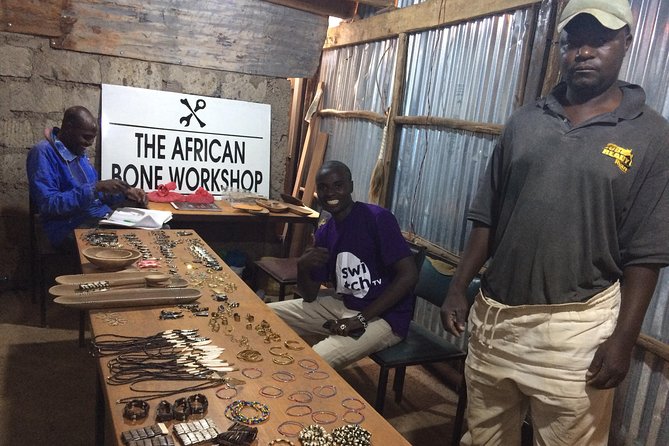
Seeing work at the African bone workshop
The African bone workshop is one of the tour’s more unusual stops. It offers a look at local craft and small-scale work, rather than presenting Kibera only through housing and poverty.
The workshop is also a useful reminder that discarded material can become a source of income. Accounts of the tour refer to cow-bone jewelry and a bone factory, so you may see how bone is turned into handmade products. The exact demonstration can vary, but the stop gives you something concrete to discuss with your guide: employment, skill, enterprise, and the ways people build livelihoods with limited resources.
If you buy something, consider it a direct way to support local work, but do not feel pressured. The value of the stop is not just the object for sale. It is the chance to see a working enterprise and meet people making a living through craft.
Some accounts also describe a community empowerment bag-making company. It is not listed as a fixed stop in the basic route, so treat it as a possible addition rather than a promise. Ask Kevin or Ismael when you meet them if the route includes it that day.
Visiting a school and orphanage project
The school and orphanage stop is likely to be one of the most affecting parts of the morning. You may see a local school serving children who have few resources, including orphans. The guides can explain the effort to educate children and the role of small community projects in a place where formal support is limited.
This visit adds a hopeful note without hiding the hard facts. The accounts describe schools created with little funding and efforts to help promising pupils continue to boarding school. That gives you a better sense of how education can change a child’s options, and how much work is required to keep a modest school running.
You should approach this stop with particular care. Children are not scenery, and a school is not a photo backdrop. Let the guide set the tone, follow the school’s rules, and ask before taking pictures or offering anything directly. The purpose is to learn about the project, not to turn children into part of your holiday story.
The emotional effect can be strong. You may leave impressed by the determination of teachers and families, yet frustrated by the lack of basic services described along the route. That mixture is more honest than a simple tale of misery or inspiration.
A few more Nairobi days to weigh up
- Nairobi National Park Half-Day Tour; Free Wi-Fi connection
★ 5.0 · 878 reviews - Nairobi: National Park & Optional Elephants & Giraffe Center
★ 4.8 · 874 reviews - NAI NAMI: Nairobi Storytelling Tour with Street Children
★ 5.0 · 792 reviews - Nairobi National Park Half-Day Game Drive
★ 4.5 · 738 reviews
Entering Kevin’s family home

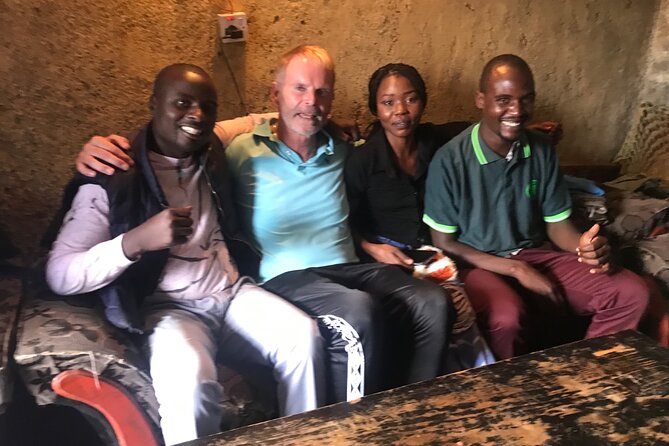
A visit to Kevin’s house and family is the tour’s most personal feature. You may also see his parents’ home, depending on the route and guide. This is a rare chance to move beyond public streets and understand how a family uses its private space.
The value is in the ordinary details. A family home can show how people study, rest, cook, talk, and share limited room. Accounts describe the family as warm and welcoming, with the relaxed mix of joking and arguing found in families everywhere. That human scale is important. It replaces an outsider’s general picture with a real introduction.
You should accept this invitation with humility. Keep the visit short if the guide indicates that, ask before touching anything, and do not assume that hospitality means every subject is open for discussion. A personal welcome is a privilege, not a right.
This stop also explains why a local guide matters. Kevin or Ismael can connect the physical space to personal history. You can ask what has changed, what remains difficult, and what family members hope for. Those answers are likely to be more useful than statistics alone.
The landfill, train track, and harder questions
The landfill and train track show the tougher side of the route. These are not scenic attractions, but they help explain the dangers and limits built into daily life. Accounts describe children moving through areas with holes, broken metal, and other hazards. You may find the contrast painful: children can laugh and play even when their surroundings are plainly unsafe.
This is where the tour can feel frustrating as well as moving. You may wonder why basic water, toilets, and showers are not available to more people. The experience does not solve those problems, and it should not pretend that a few hours of sightseeing can do so.
A responsible tour should leave you asking better questions, not simply feeling grateful for your own circumstances. Listen to how the guide describes community action, government support, and the work of local schools and businesses. Kibera is not one single story, and your guide can help you see both hardship and initiative.
The terrain is a serious consideration here. The walk may be precarious, especially after rain. Closed-toe shoes are essential, and you should wear clothing you do not mind getting dirty. If uneven surfaces, narrow routes, or a long walk are difficult for you, choose a different Nairobi activity.
What $65 buys you

The price is $65 per person. For a private tour lasting about four hours, with hotel pickup and drop-off, that is a fair price if you value personal guiding and local access. The listed admission cost for the Kibera stops is free, so you are mainly paying for the guide, transport arrangements, time, and the access created by local relationships.
The value is not in the number of sights checked off. It is in having someone explain what you are seeing and introduce you to places that would be hard to approach alone. A group paying the same price for a standard city outing might receive more polished transport or broader sightseeing, but not this level of personal contact.
Food and drinks are not included. Plan to eat before the 8:00 a.m. start or after you return, and carry anything you need according to your hotel and guide’s advice. The information does not promise a meal or tasting stop.
Because the tour is private, the total cost may feel more worthwhile for couples, families, or friends traveling together. A family with children aged eight and nine has taken part successfully, but parents should decide if their children can handle the walking, difficult ground, and serious subject matter.
Safety, respect, and practical preparation

The strongest safety feature is the local guide’s standing in the community. People know Kevin and Ismael, and that can make introductions and movement through the area easier. Several accounts describe feeling safe, including when touring alone.
No guide can remove every city risk. Keep valuables out of sight, stay with your guide, and follow directions at crossings, markets, and narrow paths. Ask about photography instead of assuming it is acceptable.
Wear:
- Closed-toe shoes with a firm sole
- Clothes that can handle dust or mud
- Comfortable clothing for several hours of walking
- A small bag that you can keep close
Rain can change the experience quickly. The operator requires good weather and may offer a new date or full refund if poor weather leads to cancellation. You can cancel for a full refund up to 24 hours before the start time. Changes or cancellations inside that 24-hour window are not accepted for a refund.
The tour is described as suitable for most people, but that broad statement should not override the specific warning about terrain. If you have balance or walking issues, think carefully before booking. This is an active walk through a difficult urban setting, not a vehicle-based tour with occasional stops.
Is Kevin’s Kibera Slum Tours worth booking?
I would book this tour if you want a serious, personal look at Nairobi and are prepared to meet Kibera on its own terms. The local guide, private group, family visit, school, craft workshop, and market create a fuller picture than a quick drive past the settlement.
I would not book it if you want a light morning, easy paths, or a tightly controlled sightseeing program. The route can be dirty and physically demanding, and the subject matter may stay with you long after the pickup vehicle returns.
For the right person, $65 is a sensible price for four hours with Kevin or Ismael. Bring sturdy shoes, keep your expectations respectful, and leave room for a complicated experience that includes warmth, hardship, humor, enterprise, and difficult questions.
FAQ
Where does Kevin’s Kibera Slum Tours take place?
The tour takes place in Kibera, Nairobi, Kenya.
How long does the tour last?
The full experience lasts approximately four hours. The Kibera portion of the itinerary is listed at about three hours.
What time does the tour start?
The stated start time is 8:00 a.m.
Is hotel pickup available?
Yes. Pickup and drop-off are offered from hotel accommodation in Nairobi.
Is this a private tour?
Yes. Only your group participates in the activity.
How much does the tour cost?
The price is $65 per person.
Which guides lead the tour?
The tour is led by Kevin or his brother Ismael, both of whom are connected to Kibera. The guide assigned to your booking may vary.
What places can I visit during the tour?
The route includes an African bone workshop, an orphanage school, Kevin’s house and family, a landfill, a train track, and the main street market.
Are food and drinks included?
No. Food and drinks are not included.
Can I cancel for a full refund?
Yes. You can cancel at least 24 hours before the experience start time for a full refund. If poor weather causes the operator to cancel, you will be offered another date or a full refund.
Recently added around Nairobi
- Nairobi; City Walk Tour★ 4.5 · 3 reviews
- Private 3-Day Masai Mara Safari Adventure★ 5.0 · 3 reviews
- Kenya safari★ 5.0 · 3 reviews
- 2 Days Amboseli National Park Safari★ 3.5 · 3 reviews
- 11-Days Best of Kenya & Tanzania Big 5 Safari on a 4×4 Jeep★ 5.0 · 3 reviews
- Full Day, Small Group Guided Tour to Amboseli National Park★ 4.5 · 3 reviews
- 10-Days Explore Kenya Wildlife Private Safari★ 5.0 · 3 reviews
- Nairobi: Giraffe Center, Beads Factory & Bomas of Kenya Tour★ 4.5 · 3 reviews
Nairobi Tours, compared.
Nairobi National Park Half-Day Tour; Free Wi-Fi connection
Read our review →
National Park & Optional Elephants & Giraffe Center
Read our review →
NAI NAMI: Nairobi Storytelling Tour with Street Children
Read our review →



Elephant Orphanage and Giraffe Center Tour with Options
Read our review →Browse the lists this tour appears in